
Why biomedical technology matters beyond “buying a new device”
In hospitals, clinics and care networks, timely diagnosis and safe treatment increasingly depend on a coherent technology fleet: imaging, monitoring, OR, respiratory therapy, sterilization and patient flow. It is not about stacking brands — it is about closing clinical and operational gaps with documented, installable and supportable equipment in Colombia.
This article guides purchasing, biomedical engineering and clinical leadership on how technological advances support diagnosis and treatment — without invented clinical claims and with an institutional decision lens.
1. Diagnosis: see earlier, decide better
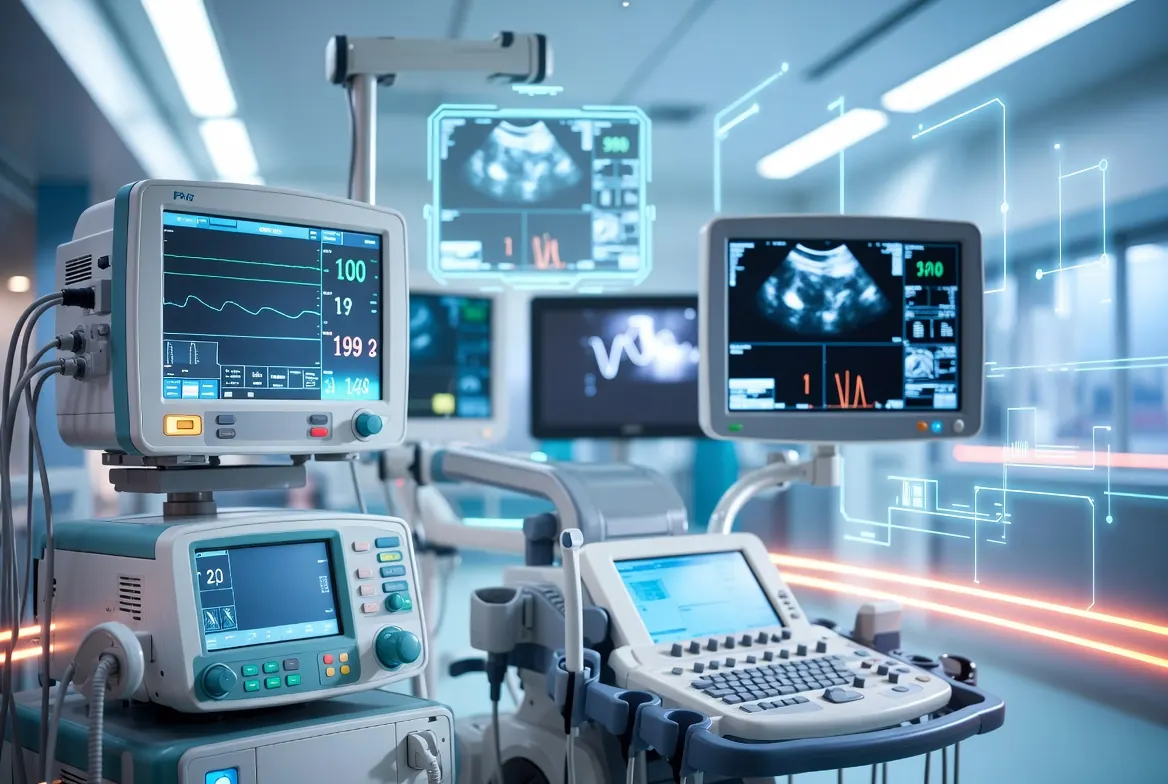
Advances in imaging, ultrasound and multiparameter monitoring help institutions:
- Obtain clearer information at the right moment (clinic, ED, ICU, OR).
- Reduce “blind interpretation” when a service is still under-equipped.
- Standardize criteria across shifts when the fleet is homogeneous and calibrated.
In practice, a sound technology diagnosis means:
- A defined use case (which clinical question the device must answer).
- Patient flow (room time, transfer, preparation).
- Traceability (sheets, applicable sanitary registrations, maintenance).
Technology without a clear use case often becomes underused CapEx.
2. Treatment and procedures: precision, safety and continuity
In OR, anesthesia, infusion therapy and life support, modern technology contributes:
- Better visualization and parameter control during procedures.
- Less operational friction when install, training and consumables are planned.
- Service continuity when preventive maintenance and parts are predictable.
I-ME supports projects where the device is not an isolated SKU: room, utilities, operators and commissioning scope are evaluated together.
3. What successful institutions usually prioritize
| Priority | Why it matters | | --- | --- | | Sheet evidence (not brochure only) | Avoids buying unused capabilities | | Local support and training | The device “lives” on the shift, not on the quote | | Service fit | OB-GYN, ICU, radiology or CSSD have different constraints | | Total cost of ownership | Consumables, calibration and downtime weigh as much as purchase price | | Clear regulatory path | INVIMA and manufacturer docs must be confirmed per reference |
4. Turn technological advance into a project (not an impulse)
- Diagnose the bottleneck (scheduling, image quality, CSSD saturation, alarms, transfer).
- Map it to an equipment family (imaging, monitors, OR, sterilization, service robots, etc.).
- Compare published catalog alternatives in service language.
- Agree install, training and support before commercial close.
- Measure adoption at 30/60/90 days (real use, incidents, staff satisfaction).
5. I-ME’s role in this cycle
I-ME International Medical Enterprise advises Colombian institutions on selection, acquisition and implementation of certified biomedical equipment. The approach is consultative: understand the clinical-operational problem, propose catalog references and support commissioning.
If your institution is evaluating imaging, OR, monitoring or another line, start from the [Knowledge Center](/en/knowledge/) or an [advisory request](/en/contact/).
FAQ
Does technology “cure” disease by itself?
No. Devices support diagnosis, monitoring and procedures. Clinical outcomes depend on people, protocols and patient context. We avoid unverified clinical claims.
Should you always buy the most advanced option?
No. The most advanced option without adoption or support often frustrates teams. Prefer the technology level your service can operate safely and continuously.
Where to start with a limited budget?
At the bottleneck with highest impact (safety, room productivity or service continuity) and with a phased plan.