
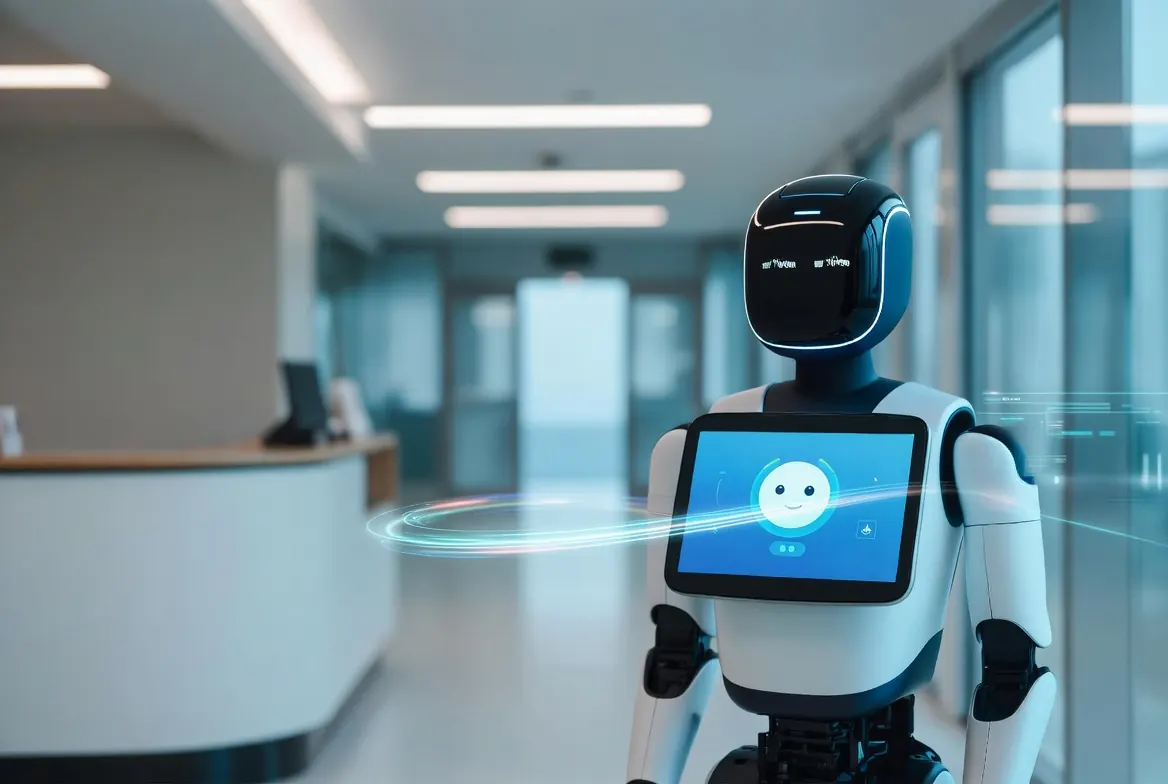
The problem is not only “short staffing”: it is repetitive task load
In reception, waiting areas, corridors and information points, clinical and administrative staff spend time guiding visitors, repeating answers, escorting short transfers and absorbing demand peaks. That load does not always require a clinician — but it consumes shifts and raises operating cost.
Assistive / service robots (reception, telepresence, institutional delivery) do not replace clinical judgment. Their institutional value is automating fractions of the flow so people focus on higher-value work.
1. Where assistive robots help
With references published in the I-ME catalog (PadBot line and related items), institutions typically evaluate:
- Reception and wayfinding: greetings, FAQs, routing to services.
- Telepresence: remote accompaniment, administrative rounds, distant support.
- Internal delivery: non-critical material moves across campus points.
- Extended-hours presence: information coverage when the lobby saturates.
Fit depends on building maps, safety protocols and the exact role to automate.
2. How they can relieve staff pressure (without invented ROI)
We do not promise a generic savings percentage. Observable mechanisms include:
- Fewer interruptions to admissions staff from repeated questions.
- Ordered routing of visitors to the right desk.
- Peak support (start of day, shift change, campaign days).
- Remote presence when a supervisor cannot travel.
- Standardized institutional messaging (hours, requirements, routes).
Real impact is measured in freed hours, perceived wait time and wayfinding incidents — with a before/after baseline in a pilot.
3. What NOT to expect from an assistive robot
- It does not diagnose or treat patients.
- It does not replace nursing, physicians or institutional security.
- It does not fix a chaotic layout or a missing protocol by itself.
- It does not remove the need for a human service owner.
The robot is a flow resource. Service design remains human.
4. Checklist before buying or piloting
- [ ] Which repetitive task consumes the most staff time today?
- [ ] Can the building support safe navigation (maps, restricted zones, charging)?
- [ ] Who operates, updates Q&A content and owns incidents?
- [ ] Is there a 2–4 week pilot with simple metrics?
- [ ] Does scope include I-ME install, training and support?
5. How I-ME approaches these projects
- Listen to the operational bottleneck (not the “trendy robot”).
- Published catalog alternatives by role (reception, telepresence, delivery).
- Demo evaluation when applicable.
- Proposal with implementation and support scope.
Explore the [robotics projects page](/en/robotics-rehabilitation/) or request guidance via [contact](/en/contact/).
FAQ
Does a robot automatically cut payroll?
Not automatically. It can relieve load and improve coverage of repetitive tasks; any staffing decision is institutional and should be measured with pilot data.
Does it work in every hospital?
It depends on layout, connectivity, adoption culture and use case. That is why we recommend a pilot before broad CapEx.
Does it integrate with clinical flow?
As operational support in non-clinical or transition zones. The clinical boundary stays under protocols and authorized staff.