
The question
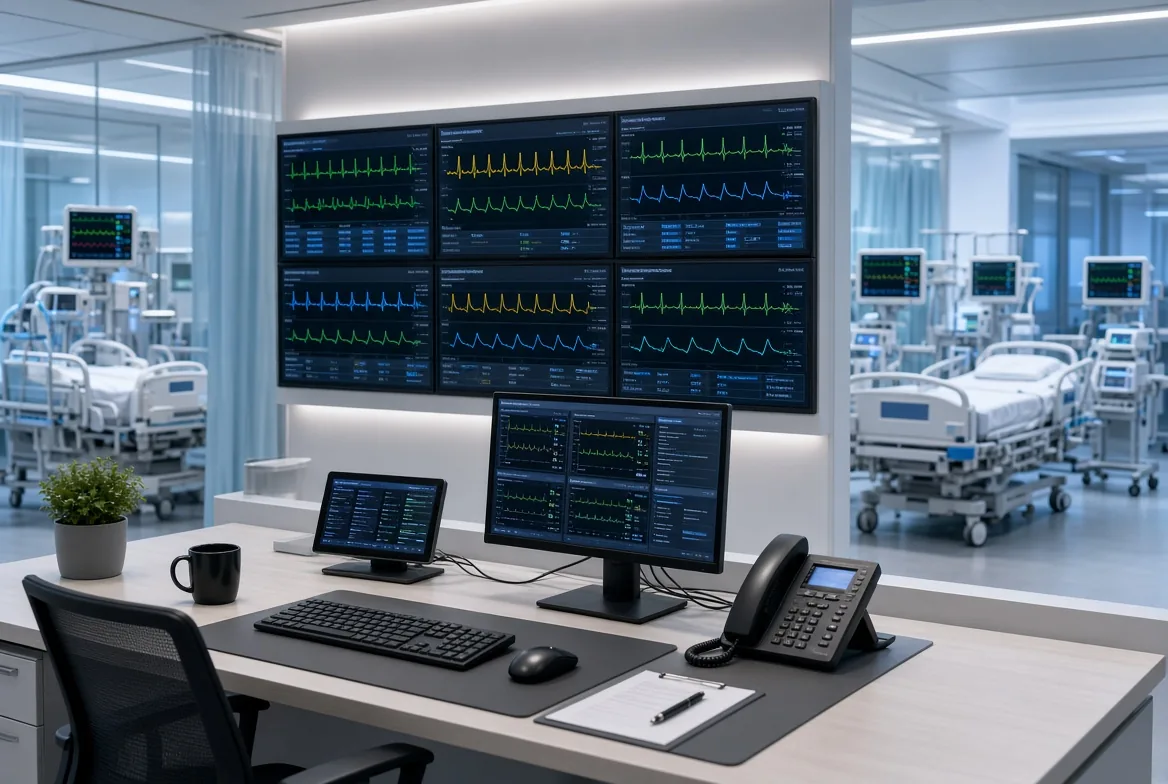
Each bedside monitor works on its own. A multi-bed central monitoring station brings the data from several bedside monitors together at one station so they can be watched at once. This guide helps decide when that investment pays off and what it requires.
Criteria validated by I-ME's clinical engineering team (September 24, 2026).
What a central station does (and doesn't)
A central station measures no parameters: it receives and displays data from the bedside monitors and adds alarm review, trends and reports. The catalog's Multi-Bed ICU Central Monitor, for example, handles 8 to 16 beds depending on configuration.
When it pays off
A multi-bed central station usually makes sense when any of these apply:
- The unit has 4 or more continuously monitored beds.
- Nurses need centralized supervision, especially when each nurse covers several patients.
- Traceability is needed: reviewing past alarms and producing reports for audits or committees.
- Integration with the electronic health record (HIS/EMR) is a goal.
- The room layout prevents a direct view of every bedside monitor.
In small units of 1 to 3 beds, standalone monitors are usually enough and cheaper.
What it requires
- A dedicated data network or VLAN and a good-quality switch.
- Validated IP addresses or VLANs before connecting the monitors: connecting without validating causes data loss or interference.
- Staff trained on the central station: clinical engineering training should include it.
- Bedside monitors compatible with the central station and registered on it during installation.
Summary
| Situation | Sensible option |
|---|---|
| 1 to 3 beds, direct view of every monitor | Standalone monitors |
| 4 or more continuously monitored beds | Multi-bed central station |
| Several beds per nurse or no direct line of sight | Multi-bed central station |
| Audits, committees or EHR integration | Multi-bed central station |
Keep reading
- Complete guide to hospital multiparameter monitors
- Checklist for receiving and installing a hospital patient monitor
If you are sizing a unit, talk to an I-ME advisor with the number of beds and the patient type.