
What this checklist is for
A well-chosen monitor can still fail in its first week if it arrives at an ungrounded outlet, on a network the central station does not recognize, or in a unit where only one shift was trained. This checklist covers what to prepare, check and sign off from the moment the purchase is confirmed until the equipment is used on patients.
Validated by I-ME's clinical engineering team (September 24, 2026). Each model's exact requirements are in its manual and data sheet; where they differ, the manufacturer's manual prevails.
Before delivery: what the institution prepares
- A regulated power outlet (110/220 V as specified) with a verified and certified ground, per NTC 2050 (Colombia's electrical code) or the applicable local standard.
- An active, configured Ethernet (RJ45) port, if the monitor will join a multi-bed central monitoring station.
- Space and mounting system defined (wall, ceiling or pole mount) according to the room layout.
- Clinical engineering staff available to attend the receiving.
- Environmental conditions (temperature, humidity) within the range in the manufacturer's manual.
At physical receiving
- Packaging intact: no dents, moisture or signs of prior opening.
- Model, reference and serial number match the purchase order and delivery note exactly.
- Complete inventory of accessories and sensors: ECG cables, SpO₂ sensors, NIBP cuffs in the different sizes, optional modules and battery.
- No visible damage to the screen, housing, connectors, casters or mounts.
- All documents present (see the next section).
Any non-conformity is recorded in the handover record and resolved with the supplier before continuing.
Documents that must come with the equipment
Always:
- User manual in Spanish (printed or digital).
- Manufacturer's and supplier's warranty certificate.
- Factory test or initial calibration certificate.
- Copy of the current INVIMA sanitary registration (how to check it: INVIMA sanitary registration guide).
- Inventory of the accessories and sensors delivered.
On request or per contract: detailed data sheet and maintenance protocols, additional conformity certificates (for example, IEC 60601) and configuration software or updates.
Installation and commissioning
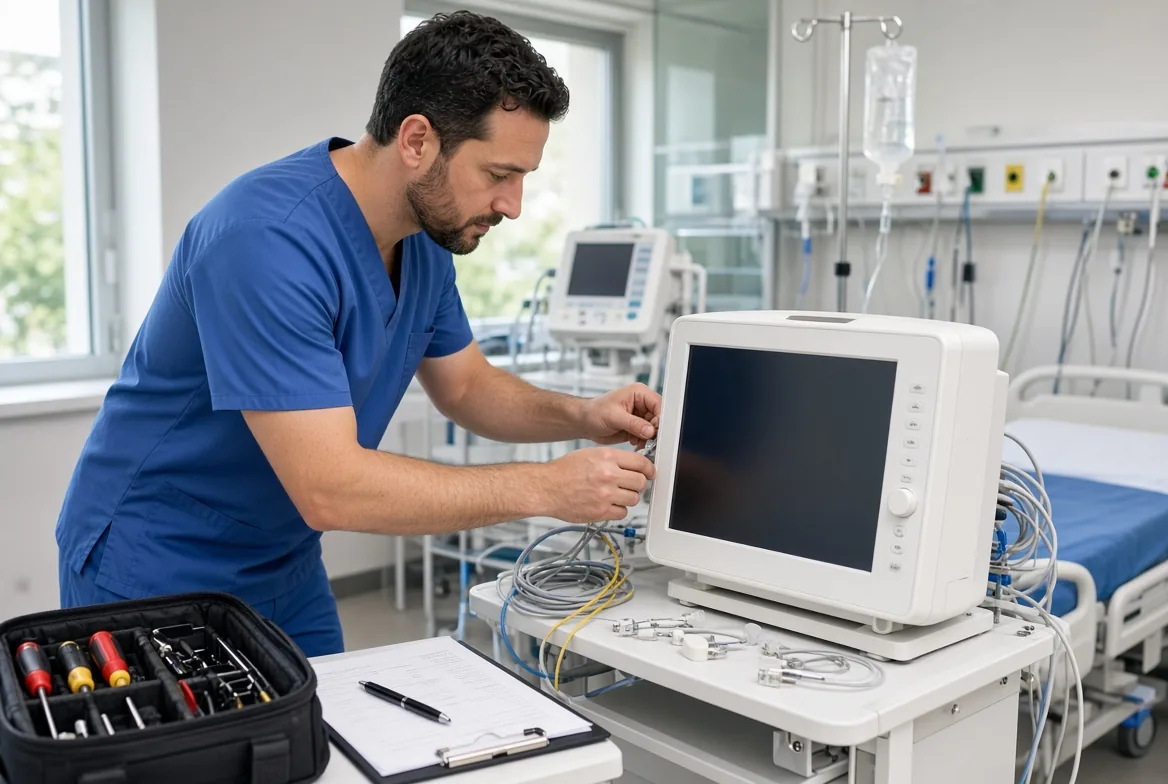
At I-ME this is done by authorized technical staff (clinical engineers or field technicians). Make sure it includes:
- Physical mounting of the monitor and its accessories at the assigned station.
- Power connection and ground verification.
- Network connection and registration on the central monitoring station, if applicable.
- Initial setup: patient profiles (adult, pediatric, neonatal), alarm limits per the unit's protocol, language, date and time.
- Communication test with the multi-bed central station.
- Handover of administrator credentials and basic training for clinical engineering.
Tests before use on patients
- Self-test at power-on.
- Verification with a certified patient simulator: ECG (rhythm and amplitude), SpO₂, NIBP, temperature and, if installed, the invasive modules (IBP, EtCO₂).
- Visual and audible alarms and their prioritization.
- Battery autonomy (minimum charge).
- Connectivity with the central station, if applicable.
The equipment is not released for clinical use until these tests are complete, and the results are recorded and signed by the supplier's technician and the institution's clinical engineering lead.
Training
- Clinical staff (nurses and physicians of the unit): 2 to 4 hours of theory and practice per group or shift, covering basic operation, alarm recognition, sensor changes, first-level troubleshooting and patient profiles.
- Clinical engineering: 4 to 8 hours on advanced configuration, first-level maintenance, basic calibration, user management, software updates and central station management.
- First-level support designated within the institution, with the supplier's technical support line.
Durations are approximate and adjusted to the size of the equipment fleet and the number of shifts.
The delivery and installation record
A record should be signed with, at a minimum:
- Institution and unit details.
- Brand, model, serial number and INVIMA registration of the equipment.
- Detailed inventory of accessories and consumables delivered.
- Results of the functional tests.
- Staff trained (names and roles).
- Observations and open items.
- Signatures of the supplier's technician, the clinical engineering lead and, where applicable, the head of the unit or ICU coordinator.
The original stays with the institution.
Common mistakes to avoid
- Not checking the ground or using unregulated outlets: intermittent faults and electrical safety risks.
- Receiving without a thorough inventory: missing items surface weeks later.
- Leaving alarms at factory defaults instead of adjusting them to the unit's protocol.
- Training only one shift, or staff who do not operate the equipment: incorrect use at night and on weekends.
- Underestimating space and cable management: cluttered stations and trip hazards.
- Connecting to the central station without validating IP addresses or VLANs: data loss or interference.
- Not registering the equipment in the institution's biomedical asset management system.
Keep reading
- Complete guide to hospital multiparameter monitors
- Multi-bed central monitoring station or standalone monitors
If you are preparing monitors for a unit, talk to an I-ME advisor to coordinate installation and training.